(The Definitive 2026 Guide to Resume Length)
The “one-page resume” rule has become one of the most anxiety-inducing myths in the job market. Candidates shrink margins, remove strong achievements, and squeeze text into tiny fonts just to avoid crossing onto a second page.
But here’s the truth most career experts and recruiters agree on: the rigid one-page rule is outdated—and for many professionals, actively career-limiting. What matters today is relevance, clarity, and strategic presentation, not an arbitrary page count.
For job seekers who want a modern, optimized layout, the answer in 2026 is far more nuanced than “one page only.” This guide breaks down when sticking to one page is smart and when using a two-page document is not just acceptable but essential.
Why the One-Page Rule Is Fading
(And Why Two Pages Can Actually Be Better)
For decades, the one-page rule made sense when hiring managers dealt with stacks of paper resumes. A single page was simply faster to scan. But the hiring landscape has evolved due to two major shifts.
1. Applicant Tracking Systems (ATS)
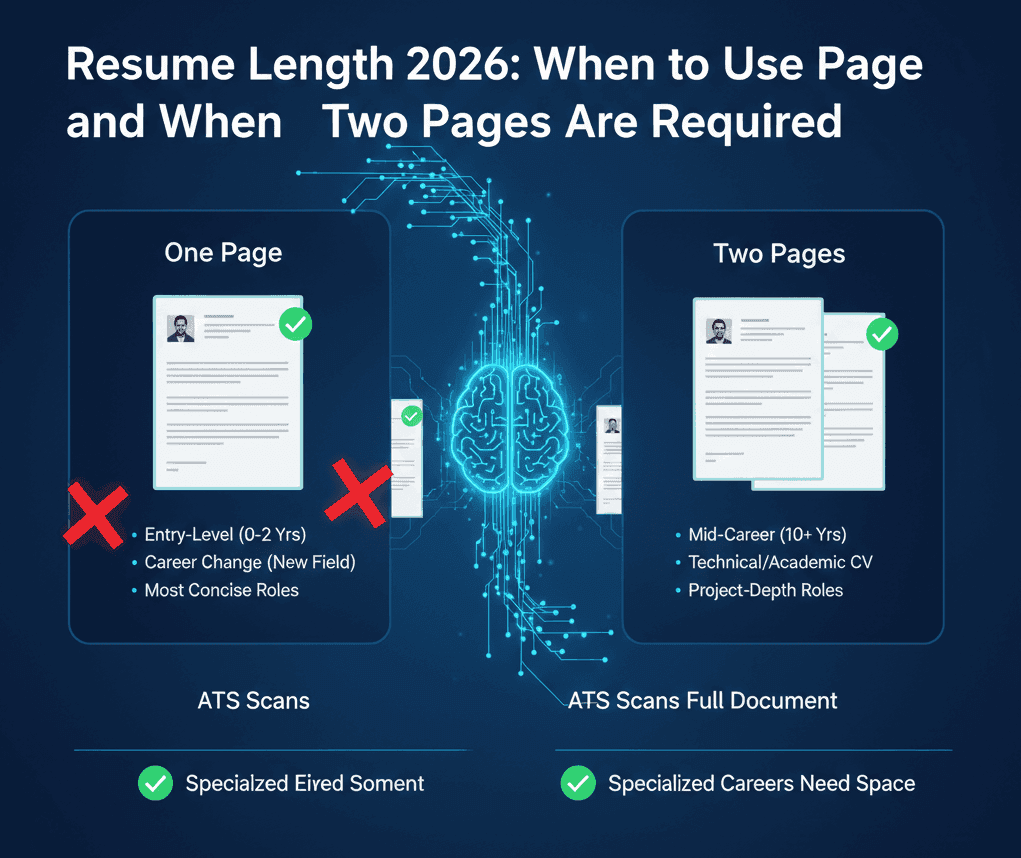
Modern ATS platforms scan the full document and extract keywords, job titles, technical skills, certifications, and achievements—regardless of length. The system does not penalize a longer resume. In fact, a slightly longer document often performs better because it includes richer, more relevant content.
2. Longer and More Specialized Career Paths
Today’s professionals build deeper expertise across fields like cybersecurity, biotechnology, data science, digital marketing, and engineering. Compressing a decade of accomplishments into a single page often means removing the very achievements that prove your value.
Bottom line: If your resume feels cluttered or if you’ve had to remove meaningful results simply to save space, the problem isn’t the length—it’s outdated formatting.
When a Two-Page Resume Is the Right Choice
The length of your resume should reflect the depth of your experience, not an old rule. In many cases, two pages are not only appropriate but expected.
1. You’re Mid-Career or Senior (10+ Years of Experience)
If you’ve spent a decade or more building your career, recruiters expect to see your progression, leadership impact, and quantified achievements. Restricting all of that to one page often weakens your story. A two-page format allows your most relevant experiences (typically the last 5–7 years) to shine on page one, while page two supports your narrative with earlier roles and accomplishments that add context.
2. You’re Submitting an Academic or Technical CV
Academia, research, science, medicine, and advanced consulting roles require a curriculum vitae—not a condensed resume. A CV is meant to be comprehensive, covering publications, research grants, teaching experience, mentorship, conference presentations, and patents. For early-career PhDs, two pages are typical. For senior researchers or faculty, three or more is standard.
3. Your Industry Requires Project Depth
Roles in tech, engineering, data, product, or UX often require detailed proof of execution. A second page provides space to explain methodologies, model performance, system design work, analytical insights, and user research outcomes. Rather than cramming everything into tiny text, page two becomes a structured extension of your technical story.
Avoid the “1.25-Page Resume” Mistake
If your resume spills slightly onto a second page, it can look disorganized and unrefined. A document that ends at one and a quarter pages feels unfinished and visually unbalanced. The rule of thumb is simple: commit to one full page or two full pages. Never linger in between.
If needed, simplify older roles into a brief “Prior Experience” section listing only the essentials—job title, company, and dates—without detailed bullets.
Quality Always Beats Quantity
A two-page resume isn’t a problem. Irrelevant content is.
Your resume is successful when every section earns its place, when achievements are clearly stated and measurable, when the layout is easy to skim, and when the content is tailored to the role you’re applying for. A two-page document is only effective if both pages work together cohesively, without fluff or repetition.
Resumes fail when the second page becomes a dumping ground for unnecessary information, when older roles overshadow recent accomplishments, or when the document feels cluttered and disorganized.
Want to Stop Stressing About Resume Length?
Formatting shouldn’t feel like a high-stakes battle.
Tools like FirstResume.ai help you structure your experience clearly and strategically—ensuring your resume stays ATS-friendly, keyword-aligned, cleanly designed, and professionally formatted, whether it ends up being one page or two.
Stop shrinking your accomplishments. Start showcasing them.
Get your competitive edge today.