Resume tips: How many skills is too many on your resume?
Let's get straight to the point.
You’ve heard the rules: “Only list 10 skills!” or “Your resume is too long if you have more than 15!” This advice is confusing, and it makes you think there’s a secret number you need to hit.
The exact number of skills on your resume does not matter.
It is a bad question.
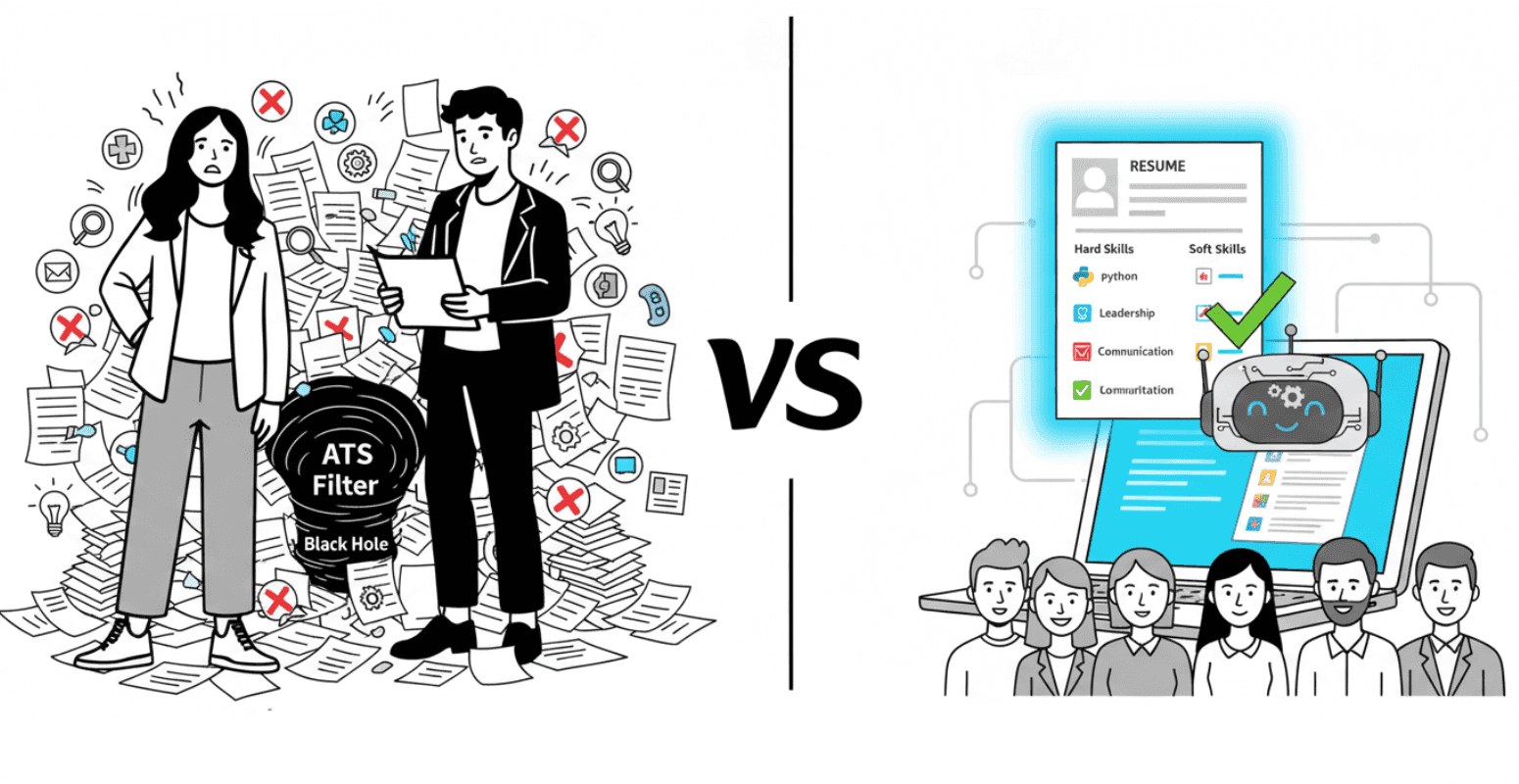
Stop counting your skills. Your real goal is not to have a high number. Your goal is to pass the test given by the ATS (Applicant Tracking System) the computer that reads your resume first and then give the hiring manager a quick win.
You need a strategy, not a number. Here is the easy, 3 step plan.
Your skills go into two simple groups
You need both kinds of skills on your resume.
1. Hard skills (What you can do)
These are the technical things you learned: Python, SQL, AWS, Accounting, Microsoft Excel, Adobe Photoshop, etc.
Why they matter: The ATS robot looks for these exact words. If the job post says you need SQL, the robot searches for "SQL." If it finds it, you pass.
2. Soft skills (How you work)
These are your people skills and personal work habits: Leading Teams, Good Communicator, Solving Problems, Working with Others, Being Flexible, etc.
Why they matter: The human recruiter wants to see these. They show you are a good person to hire and work with.
Most good resumes, especially for people with some experience, will have about 8 to 15 skills in total, with a good mix of both Hard and Soft. But do not try to hit that number exactly. It comes naturally from the next step.
The job description
Forget the number 10. The only right number of skills to list on your resume is the number that perfectly matches what the job ad asks for.
The job ad is your answer key. Here is your 3 step rule:
A. The must have 5-7 skills
You must find the most important skills in the job post. Go through the job ad carefully. Highlight every skill, tool, or software mentioned.
Find the repeats: Which words are used 3 or more times (like "Python," "Cloud," or "Managing Projects") These are your must have skills. You must put these on your resume. If you miss them, the ATS will filter you out.
If the job asks for five key skills that you have, your number is five. If it asks for ten, and you have them, your number is ten.
B. Show the proof (If you can’t prove it, don’t list it)
This is the biggest mistake people make. Do not just list a skill; show proof in your work history.
If you list "Leadership" in your skills list, the recruiter will quickly look for a sentence under your past jobs that backs it up, like: "Led a team of 4 people to finish the project on time and under budget."
The Simple Rule: If you cannot write a strong, short sentence under your past jobs to prove you have a skill, do not list that skill at all. It just looks like you are guessing.
C. Change Your Focus Based on Your Experience
The types of skills you emphasize on your resume should shift dramatically as your career progresses. Recruiters are looking for different things depending on your experience level.
1. New to the Job / Junior
If you are New to the Job or a Junior candidate, you must focus heavily on Hard Skills. Recruiters need to know what basic tools you can use today, such as Python, Data Entry, or a specific software program. Don't worry about having a massive list; aiming for 5–10 proven skills that you can back up with experience is perfect.
2. Senior / Expert
If you are a Senior or Expert candidate, the focus flips to Soft Skills and Strategy. At this level, recruiters already assume you are technically competent. They want to see if you can lead teams, manage projects, and solve big company problems (e.g., Leading, Planning, Solving Company Problems). Here, listing a slightly larger range of 10–15 powerful skills is expected, provided they demonstrate leadership and strategic capability.
Step 3: Keep Your Resume Clean and Simple
Your resume page is very important space. Don't waste it.
What to Skip
Don't List Simple Skills: Never list Microsoft Word, Email, or Basic Internet Use. Everyone has these. They make you look like a beginner and waste space. Don't Use Skill Ratings: Skip the bars or stars that show "5/5 for Python" or "3/5 for Excel." These are meaningless and take up too much room.
The Best Way: Make a simple list of your Hard Skills on one side and your Soft Skills on the other. Then, let your work experience section do the real selling.
Final Word: Quality is Better Than Quantity
The "magic number" is just a distraction. The real magic is making sure your resume is the perfect fit for the job ad.
If a job needs 8 skills you have, list those 8. If it needs 15, list the 15 you can prove.
Stop trying to guess a random number. Start tailoring your resume to the job description, using the exact words, and backing them up with proof. This is the only way to get the interview.
If you want an easy way to match these keywords for every job, you need a smart tool. FirstResume.ai scans the job ad, tells you the exact words the computer is looking for, and helps you fix your resume quickly. Stop getting filtered out and start getting hired faster.
Get your competitive edge today!